
The FRITZ!Box 6825 4G is AVM's answer to a very practical question: how do you get a proper router in a second home, on the road or as a backup, with no fibre and no DSL? An LTE Cat. 6 modem, Wi-Fi 6 and — at last — USB-C power. I set it up in my seaside home in Liguria with a 60 Mbit/s ho mobile SIM and use it every weekend for Ring, Roborock, smart TVs, laptops and the family's phones. It works. And with room to spare.
Technical specifications
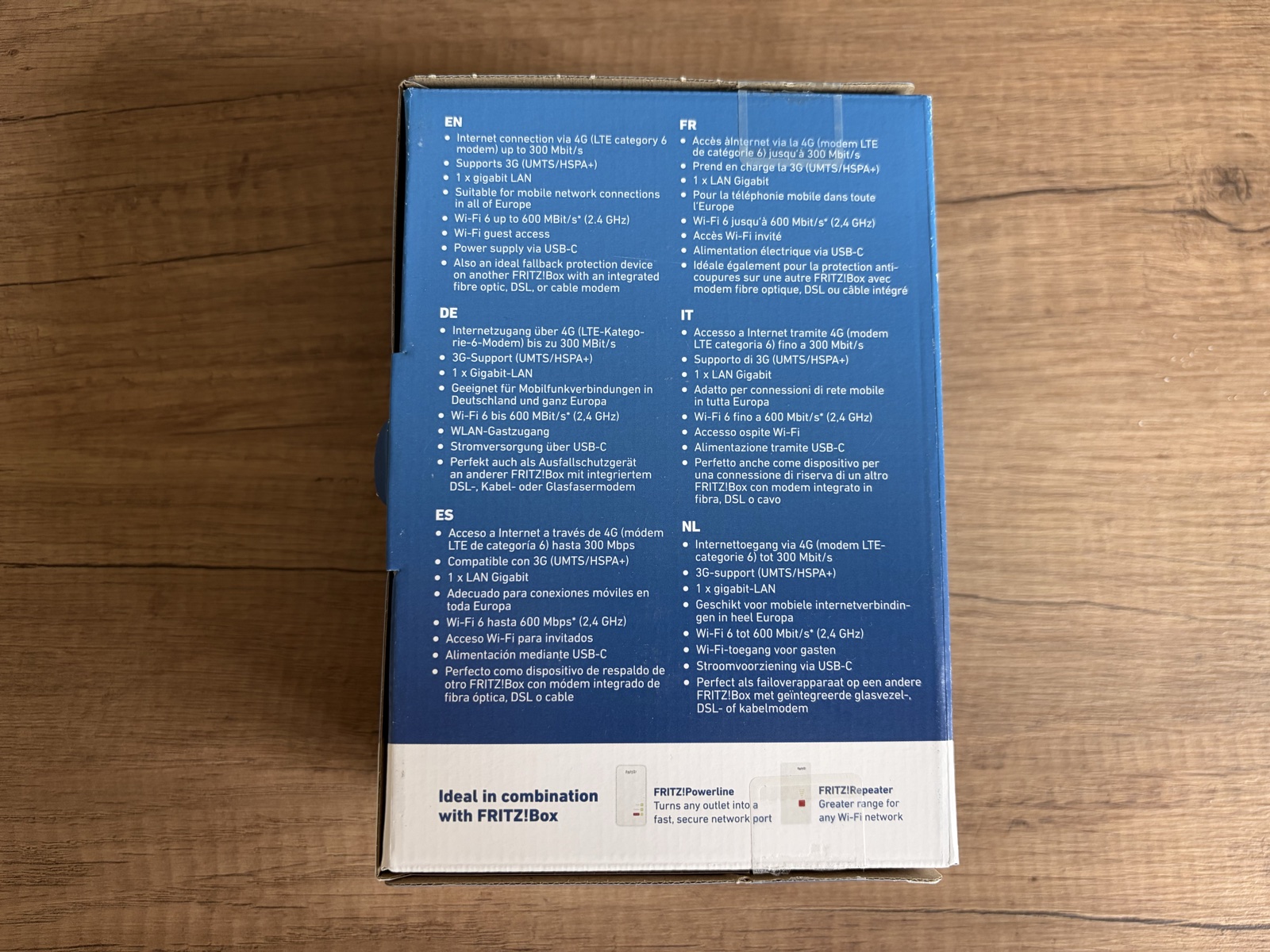
| Modem | LTE Cat. 6 (300 Mbit/s DL, 50 Mbit/s UL) |
|---|---|
| Carrier aggregation | 2CC (two aggregated carriers) |
| 3G fallback | UMTS/HSPA+ |
| Wi-Fi | Wi-Fi 6 (802.11ax) 2.4 GHz only, 2x2 MIMO, up to 600 Mbit/s |
| LAN ports | 1x Gigabit Ethernet (WAN/LAN) |
| USB | None (USB-C for power only) |
| Power | USB-C, 3W standby / 4W under load |
| SIM | Nano-SIM |
| Mesh | FRITZ!Mesh (master or repeater) |
| Security | WPA3, firewall, WireGuard + IPSec VPN |
| Dimensions | 65 x 135 x 98 mm |
| Price | 129 euros (AVM list price) |
Design and packaging
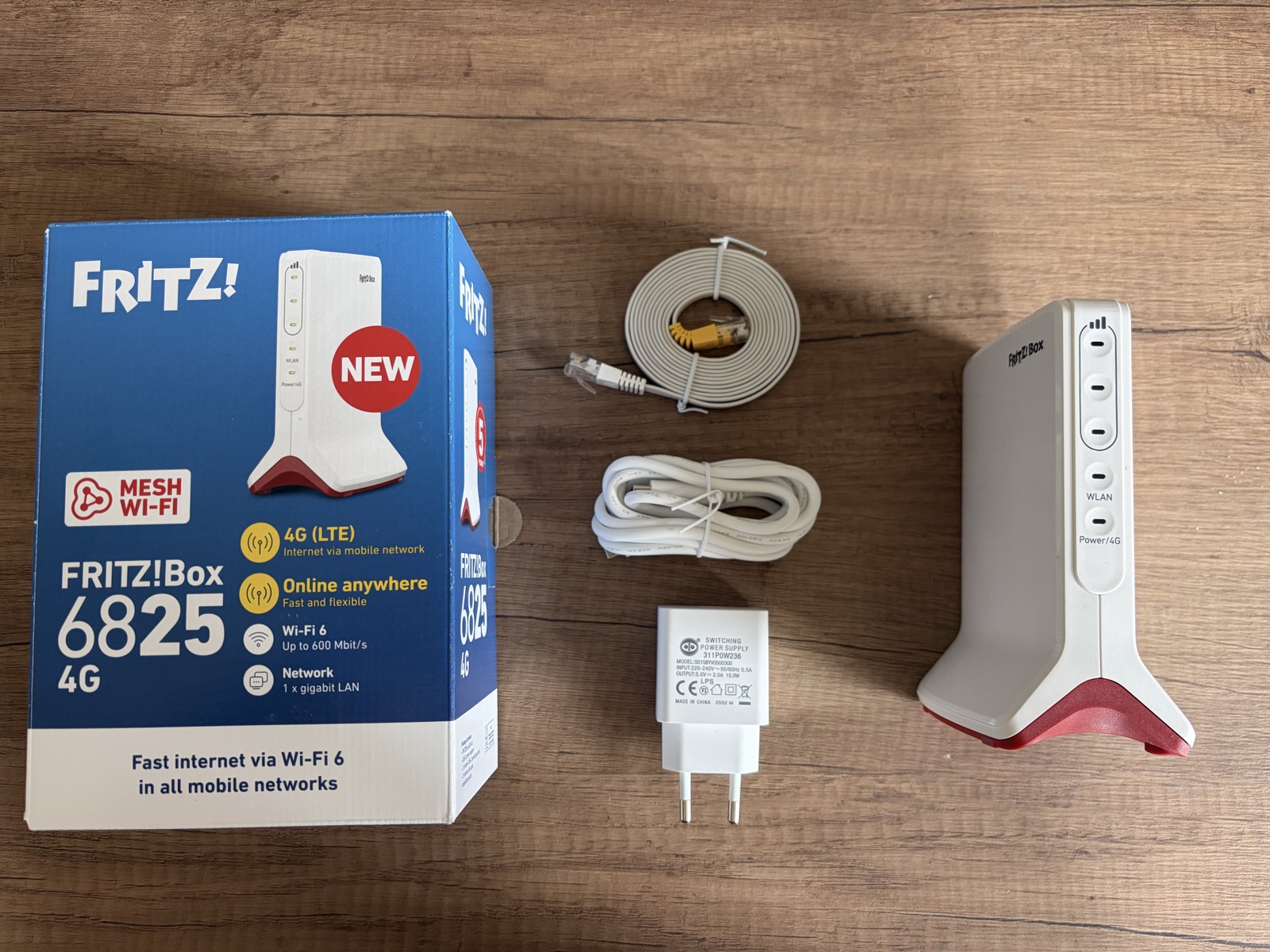
Inside the box, besides the router, you get a flat Ethernet cable, a USB-C cable and a USB-C wall adapter. No printed manual to speak of: AVM points you to the QR code on the box and to its accessibility portal.
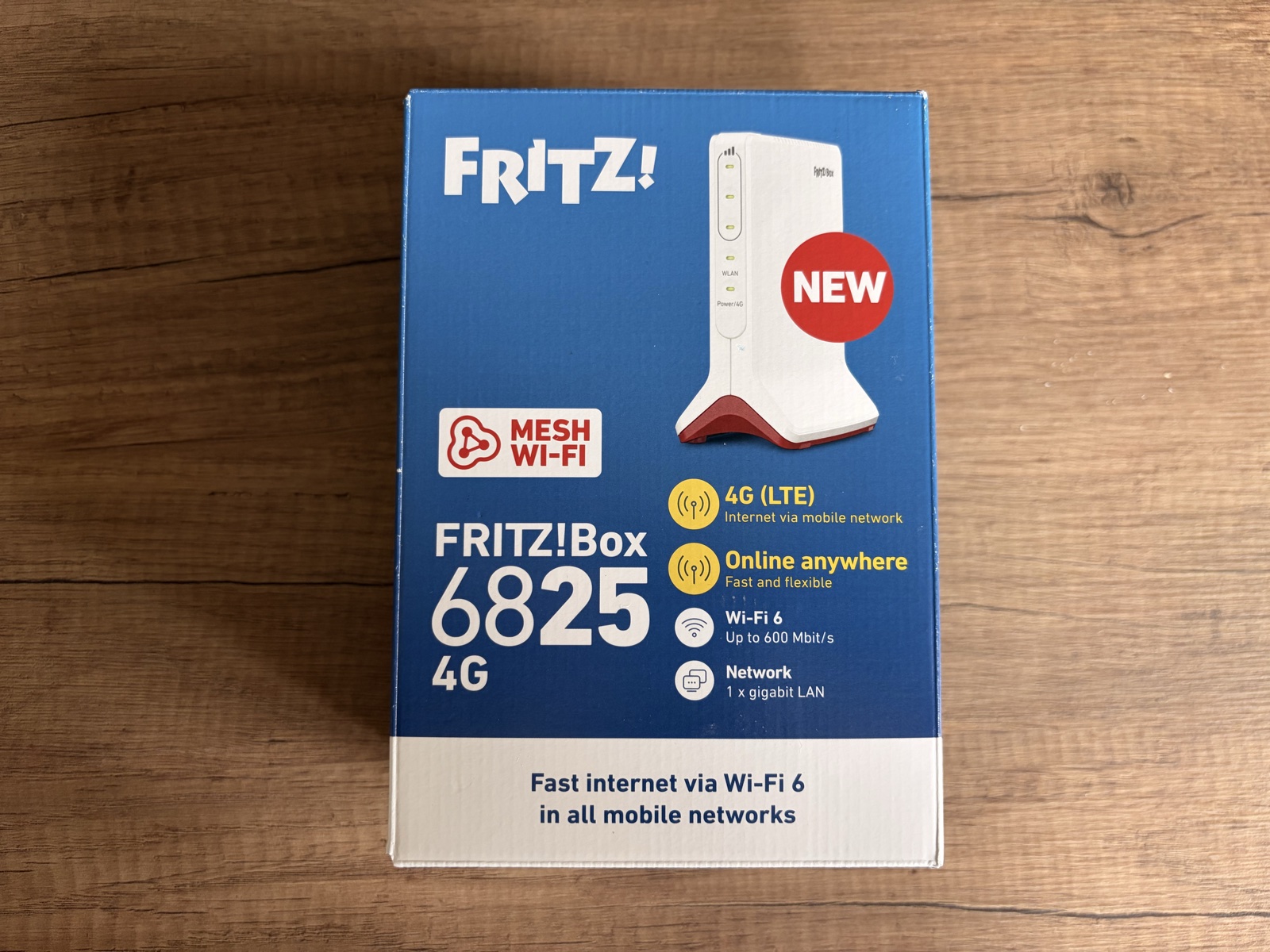
The 6825 4G breaks with FRITZ! tradition: no horizontal slab here, it stands upright on a red star-shaped base that keeps it standing without any wall mounting. It really is small — 65 x 135 x 98 mm, it fits in the palm of a hand and weighs about as much as a smartphone. By comparison, the FRITZ!Box 6850 LTE is a horizontal bar of soap three times the size, with two external SMA antennas.
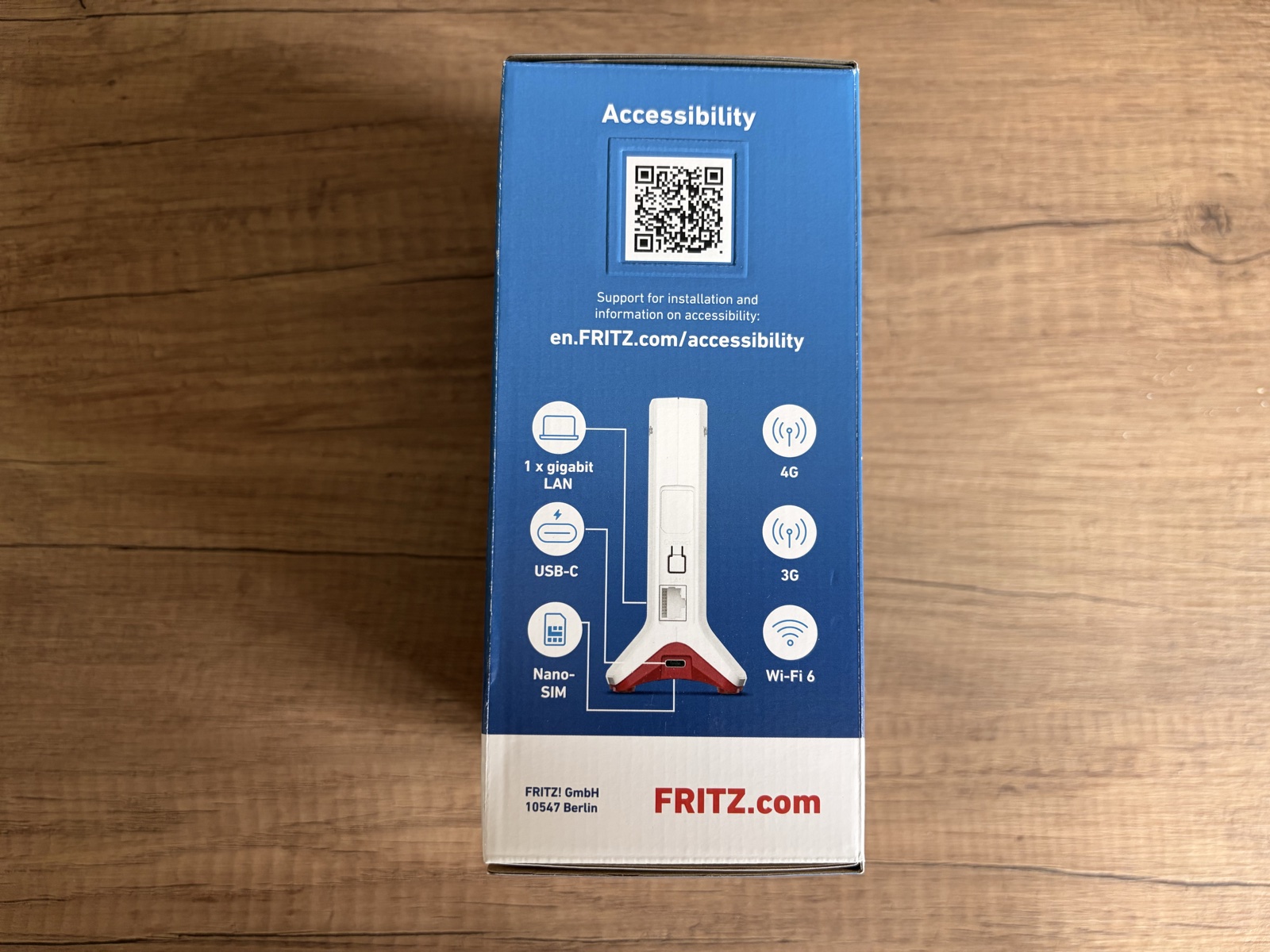
Connections: one LAN port and USB-C
On the back, the device states its philosophy: a single Gigabit Ethernet port, the USB-C power input and the Nano-SIM slot. Nothing more. On the top, the QR code for Wi-Fi access — scan it and you're in.
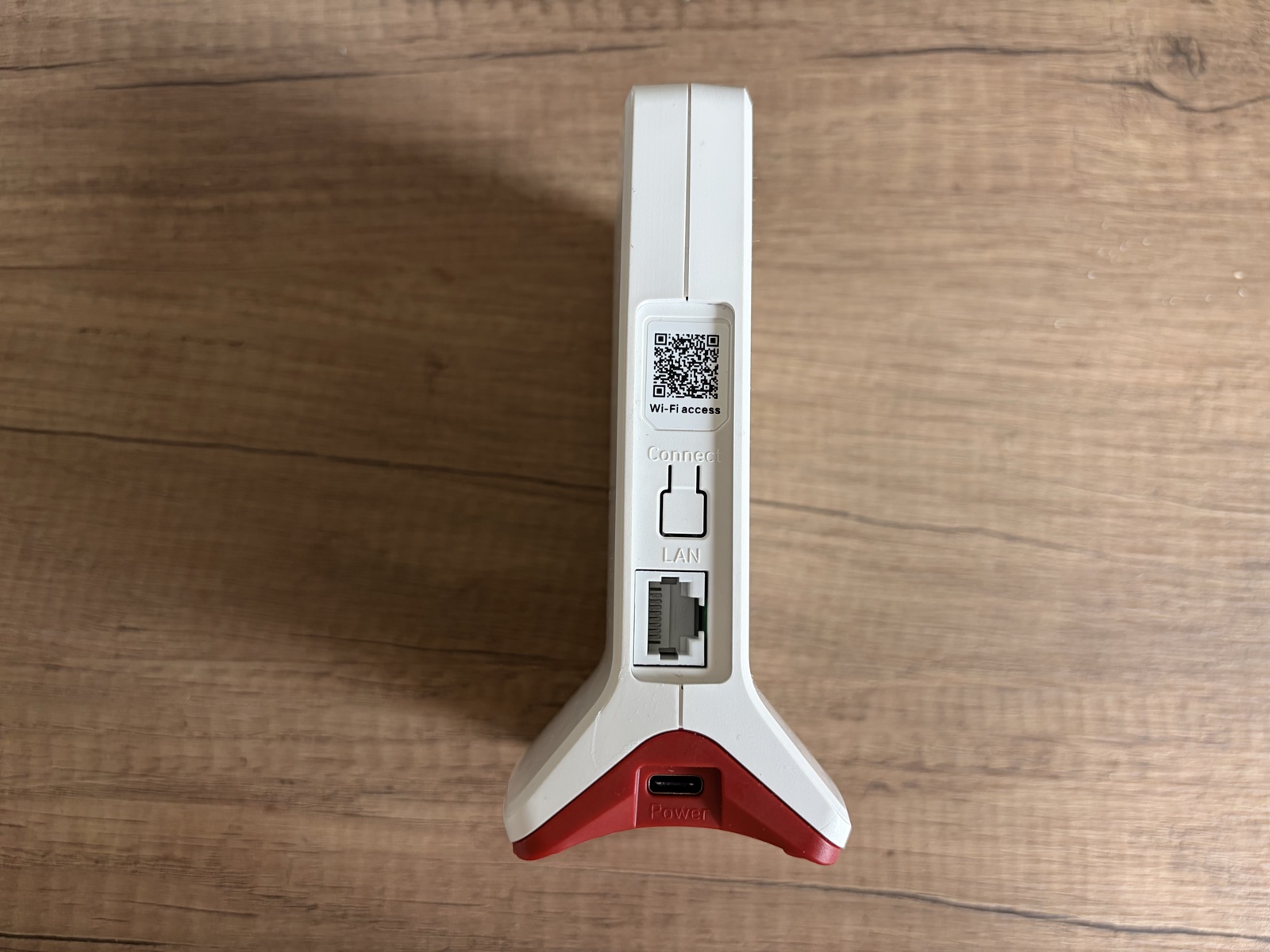
USB-C means two practical things: you can power it with any modern phone charger (I have at least five lying around the house) and — if you have a decent one — from a power bank too. For a 4G router to take along in a camper, on a boat or to a building site, that's a game changer. The 3W standby helps: with a 20,000 mAh power bank, on paper, you can keep going for more than 50 hours.
4G/LTE performance: 60 out of 60 at the seaside
The LTE Cat. 6 modem is the heart of the device: a theoretical maximum of 300 Mbit/s download and 50 Mbit/s upload with two aggregated carriers (2CC). In independent tests by connect.de it reaches 246 Mbit/s real-world download on the Magenta network. Solid numbers for a Cat. 6 — well above the 6850 LTE's Cat. 4 (150 Mbit/s theoretical).
In my real-world case, stability matters more than peak speed. The ho mobile SIM I use is capped at 60 Mbit/s symmetrical, and the 6825 4G saturates it without breaking a sweat: speed tests at 60/60 almost every time I try, even with Ring recording to the cloud, the smart TV streaming in 4K and someone on a WhatsApp call. The TIM network (which ho mobile uses) isn't exceptional in that part of Liguria, but the router picks up more signal than the average smartphone in the house: the internal antenna works.
For anyone who wants to push it further, FRITZ!OS has a built-in antenna alignment tool (RSRP/RSRQ signal shown on screen) that lets you find the best spot on the windowsill in one go. It's the same idea as the 6850 LTE but without external antennas — here you can't swap them out, you're limited to the built-in ones.
Wi-Fi 6, but only on 2.4 GHz: where the trade-off lies
This is the most controversial point of the 6825 4G. AVM has included Wi-Fi 6 (802.11ax), but only on the 2.4 GHz band, in a 2x2 MIMO configuration, up to 600 Mbit/s theoretical. No 5 GHz. A strange choice on paper — Wi-Fi 6 was born for 5 GHz — but with two clear rationales: better coverage (2.4 GHz passes through walls better) and IoT devices, which almost all live on 2.4 GHz.
In my setup the choice pays off. Ring (Stick Up Cam), Roborock QV 35A, assorted smart plugs, sockets and sensors: all on 2.4 GHz, all connected straight away. Wi-Fi 6 with TWT and OFDMA helps in a house full of IoT — less congestion, fewer timeouts, longer battery life on battery-powered devices. For laptops and smart TVs, the lack of 5 GHz is noticeable at short range (where 5 GHz delivers 600-700 Mbit/s in practice), but given that the bottleneck is the 60 Mbit/s 4G SIM anyway, in practice it makes no difference.
If, on the other hand, you're thinking of using it to saturate a 200+ Mbit/s 4G connection with a MacBook a metre from the router, then you would feel the lack of 5 GHz. But in that case the right product is a different one (the 6850 5G, or a dual-band 4G router).
FRITZ!OS: the difference that justifies the price
Under the hood is the usual FRITZ!OS, the same as on the 7590 AX and the other FRITZ!Box models. For anyone not already in the ecosystem, it's worth explaining what that means:
- Clean web setup in Italian, with a guided wizard that asks for the carrier's APN (for ho mobile, "web.ho-mobile.it" is enough)
- Native Mesh: the 6825 can act as the Wi-Fi master or join another FRITZ!Box as a repeater. Seamless roaming between access points
- Automatic failsafe: it can be configured as a backup for a main FRITZ!Box (fibre/DSL) — if the fixed line drops, the 6825 takes over
- Native WireGuard VPN (as well as IPSec), with a QR code for instant setup on mobile
- MyFRITZ! for remote access to the router and LAN devices from outside the home
- FRITZ!OS updates: AVM releases patches and new features for years — the 7590 AX is still receiving updates 6 years after launch
- Separate guest Wi-Fi with timer and bandwidth cap
- Parental controls per device, with whitelist/blacklist and time slots
Missing, compared with the bigger 6850 models: DECT telephony, Zigbee/DECT ULE smart home, a USB port for a NAS or shared printer. The 6825 4G is deliberately an "essential" device.
Seaside home, IoT, weekends: my use case
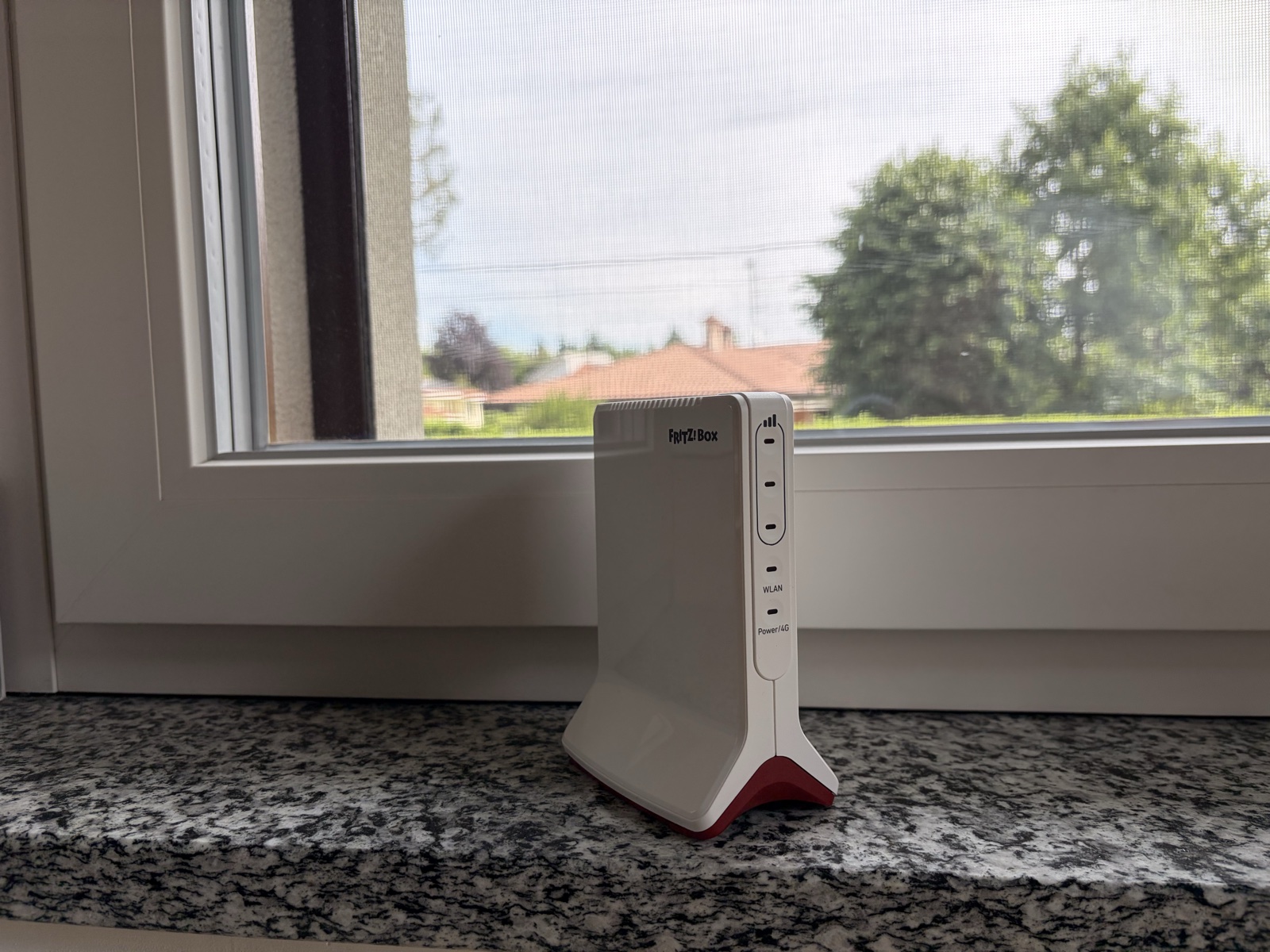
I live in Switzerland but have a seaside home in Liguria that we use at weekends and in summer. A fixed line would cost around 30 euros a month (plus activation) for a service we use 60 days a year. A rechargeable ho mobile data SIM at 5.99 euros a month for 150 GB is a fifth of the cost.
The 6825 4G has changed the equation: I used to use my phone's hotspot, which was a pain. Now I leave the router on, the SIM in, and the Wi-Fi network always there. The key point: the Ring alarm system with two cameras is active 24 hours a day, all year round — not just when we're at home. To work it needs an always-on connection, and the 6825 4G provides one 365 days a year without interruption. Likewise the Roborock QV 35A does its scheduled runs even when we're not there, the smart plugs switch on the decorative lights in the evening, and everything can be managed remotely via app as if we were there.
When we arrive at weekends: a smart TV (Netflix in 4K, it copes well), two or three smartphones, a couple of laptops. Never a problem, never any buffering. The SIM always runs at its full 60 Mbit/s download and the same upload. The router sits on a piece of furniture in the living room and covers the 70 sq m of the house without a repeater. For the outdoor pool area (8 metres away, through an outer wall) the signal is weak but still good enough for WhatsApp.
6825 4G vs 6850 LTE vs 6850 5G: which one to buy
If you're wondering where it sits in AVM's LTE range, here is a quick comparison:
| Model | Modem | Wi-Fi | Telephony | Price |
|---|---|---|---|---|
| 6825 4G | LTE Cat. 6 (300 Mbit/s) | Wi-Fi 6 2.4 GHz only | No | 129 euros |
| 6850 LTE | LTE Cat. 4 (150 Mbit/s) | Wi-Fi AC dual-band | DECT + analogue | 220-250 euros |
| 6850 5G | 5G SA/NSA (800 Mbit/s) | Wi-Fi AC dual-band | DECT + analogue | 450-500 euros |
The practical conclusion: the 6825 4G makes sense if connectivity and Wi-Fi are all you need and you want compactness, USB-C, portability and a low price. Choose the 6850 LTE only if you need DECT telephony or replaceable external antennas (rural areas). The 6850 5G only makes sense if you have decent 5G coverage and a SIM without a tight cap.
Final rating
| Design and compactness | 5/5 |
|---|---|
| 4G performance | 4/5 |
| Wi-Fi 6 | 4/5 |
| FRITZ!OS and software | 5/5 |
| Setup | 5/5 |
| Value for money | 5/5 |
| OVERALL SCORE | 4.5/5 |
Our verdict: The FRITZ!Box 6825 4G does exactly what it promises: reliable 4G connectivity, Wi-Fi 6 tuned for IoT, USB-C, the complete FRITZ! ecosystem and — almost unique in its class — firmware that is updated for years. The design choices (no 5 GHz, no telephony, a single LAN port) aren't flaws: they're the price of coming in at 129 euros in a pocket-sized format. If you need more, AVM has bigger models. But for the "second home, camper, backup or working remotely while travelling" use case, the 6825 4G is the most sensible product of 2026.
The FRITZ!Box 6825 4G has been available in Italy since February 2026 at a list price of 129 euros. On Amazon.it it can often be found for 119-125 euros.
Conclusion
I bought the 6825 4G with a specific need — replacing my phone's hotspot at the seaside home — and after a few months of real-world use I can say it's one of those products that simply work and that you forget you own. The ho mobile SIM always at full speed, Ring always online, the Roborock working on schedule even when we're not there, smart TV and laptops ready to use at weekends. At 129 euros, it's hard not to recommend to anyone who needs internet over 4G on the move or as a backup.
Read also: our FRITZ! reviews
- FRITZ!Box 7590 AX review: the king of Wi-Fi 6 DSL routers
- FRITZ!Box 6850 5G review: 5G connectivity with the FRITZ! ecosystem
- FRITZ!Box 6850 LTE review: 4G internet with no compromises
FRITZ!Box 6825 4G
Translated from the Italian original. Read in Italian


